
Fructooligosaccharides are polysaccharides or natural insoluble and non-digestible fiber compounds that promote intestinal flora growth. They stimulate the strengthening of the body’s natural defenses and provide better digestive system activity, more efficient digestion and a stronger general state of health.
Contents
- 1 What are fructooligosaccharides
- 2 Properties
- 3 Do fructooligosaccharides cause weight gain?
- 4 Uses as prebiotics
- 5 For a flat stomach
- 6 For constipation
- 7 Relationship with calcium absorption
- 8 Is oligofructose the same as fructooligosaccharide?
- 9 Similarities with inulin
- 10 Contraindications and side effects
- 11 Dosage
- 12 How to take fructooligosaccharides
What are fructooligosaccharides
They may contain a fructose molecule from which the entire fructooligosaccharide structure develops. They are also called “oligofructose” or “FOS” and one of the best known is inulin.

These biological products can be used as a sugar alternative since they have a sweet taste. They function as natural sweeteners although their sweetening capacity is less than half that of sugar. The most commonly used polysaccharide and fructooligosaccharide compounds are:
- Kerostosa
- Nistosa
- Inulobiosa
- Inulotriosa
- Inulotetraosa
- Bifurcosa
- Fructosilnistosa
Properties
- Improve intestinal transit.
- Speed up digestion.
- Increase microbial activity in the human body.
- Protect against digestive disorders.
- Serve as a basic food source for the body’s defenses.
- Serve as sweeteners.
- Have fewer calories than sugar.
- Promote greater calcium absorption.
- Reduce lipogenesis, producing less accumulation of fats in the blood.
If you take some type of probiotic supplement, you should keep in mind that including prebiotic fructooligosaccharides is very beneficial. With them you establish the starting point for microbial flora to grow with consistency and efficiency. Taking fructooligosaccharides such as inulin provides the necessary material for beneficial bacteria to reproduce and keep the intestinal and oral flora healthy and the immune system strong.
Do fructooligosaccharides cause weight gain?
 Because they are resistant to degradation produced by saliva in many foods and by secretions of the gastrointestinal tract, fructooligosaccharides do not cause weight gain. They are not digested by human metabolism and do not release monosaccharides. That is, they travel through the entire intestinal tract intact and the microflora is responsible for consuming them. What remains is eliminated through the normal mechanism of waste expulsion from the body.
Fructooligosaccharides or FOS do not provide calories and do not cause weight gain, but they also do not serve for weight loss. However, they have properties and benefits that improve digestion and speed up the transit of other foods. They act as digestive fiber.
Uses as prebiotics
In the colon, they are fermented by colonies of anaerobic bacteria that all human beings have. This allows them to serve as food for beneficial colonies that help protect against other harmful bacteria that can cause infections and diseases.
Fructooligosaccharides capture a portion of water, which facilitates intestinal transit and provides part of the fiber necessary in the diet. They are considered natural prebiotics. Many times they can be found in processed foods as a base for probiotics. In many yogurts they are already included so that Lactobacillus casei remain viable when you consume them.
For a flat stomach
 Many of these FOS compounds, by incorporating fiber components, speed up digestion and improve the process by which intestinal gases are produced. This results in reduced gas formation. Although fructooligosaccharides are not in themselves a weight loss product, they can help support a flat stomach. They reduce abdominal bloating and discomfort caused by meteorism. This is similar to don regulo vientre plano, which is composed of lactobacilli, except that this product already includes millions of probiotics.
By including oligofructose compounds, the growth of beneficial microorganisms is stimulated. That is, providing prebiotics allows the intestinal flora to increase and improves food metabolism with lower gas production.
For constipation
By containing fiber, they help you feel lighter and go to the bathroom regularly. There are products for constipation that can be more potent, such as enemas or 100% fiber, so in these cases it is best to turn to them. Nevertheless, if you take fructooligosaccharides you will notice improved intestinal regularity and stool evacuation after a few days.
Relationship with calcium absorption
Some organic processes result in a change in pH and this occurs when fructooligosaccharides ferment in the intestine. There is a real drop in pH and the benefits of calcium-containing products increase due to greater bioavailability. The mineral Ca is more soluble in an acidic environment. This makes it possible in practice to absorb a greater amount from the same portion of food.
In this sense, oligofructose or fructooligosaccharides function as an element to prevent osteoporosis and bone weakness, while also promoting a greater capacity to develop strong bones during the growth stage, childhood and adolescence.
Is oligofructose the same as fructooligosaccharide?
Oligofructose is a prebiotic with a sweet taste and is used in dietary supplements since its caloric contribution is insignificant compared to other sweeteners. The different oligofructoses and fructooligosaccharides originate from fruits such as bananas and tomatoes or from sources such as yacon, which is a tuber very rich in FOS.
Similarities with inulin
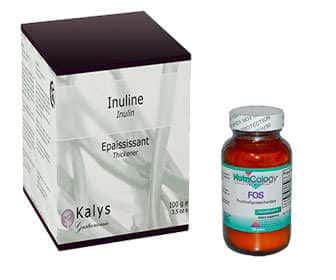 They can be considered similar compounds, although fructooligosaccharides are much more soluble than inulin. Therefore, fructooligosaccharides are usually used in the production of fermented foods since they develop better properties while maintaining the same sweetness characteristics.
Contraindications and side effects
Although they are well tested and can be included as an ingredient in many foods, some people may experience side effects when they take a product that contains them.
Because they originate from fruit, people with fructose intolerance should avoid consumption. Fructans can cause diarrhea and gastrointestinal discomfort, so the contraindications are:
- Fructose intolerance.
- Diarrhea problems.
- Inulin allergy.
- Low-fiber diet.
People who suffer from fructose malabsorption syndrome should take a maximum of 0.5 g of fructooligosaccharides per day as part of the diet.
Dosage
- Adults between 5 and 10 g per day.
- Children an amount between 2 and 5 g daily.
How to take fructooligosaccharides
Usually in the same way as any other type of dietary supplement. You should ingest one or two capsules or tablets per day. Depending on the concentration, purity or percentage contained in each tablet, the amount may vary. In any case, the number of fructooligosaccharides to take will be indicated on the packaging.


