
The perchloric acid is a compound with a chemical formula used in the textile and steel industries. It is one of the strong acids related to chlorine and perchloric oxide in water. Its handling is dangerous so places where it is sold must provide a safety data sheet to avoid burns.
Perchloric acid properties
Considered a strong acid it is very corrosive and unstable. It is known as tetraoxochloric acid (VII). When its concentration is higher than 72% it can explode so it must be handled carefully following the indications of the safety data sheet. The properties of perchloric acid are:
- Density: 1670 kg/m3 or 1.67 g/cm3.
- Molar mass: 100.46 g/mol.
- Melting point: 161 K or -112 °C.
- Boiling point: 292 K or 19 °C.
- Soluble in water.
- Colorless.
- Odorless.
- Acidity: 15.3 (+-2.0).
- CAS number: 7601-90-3.
When a solution is made with water or H2O strong acids produce a chemical reaction resulting in a pH of 1.
Perchloric acid formula
It is well known for its unstable properties although it is also widely used because it is a strong corrosive. It works well for treating metals and its perchloric acid formula is: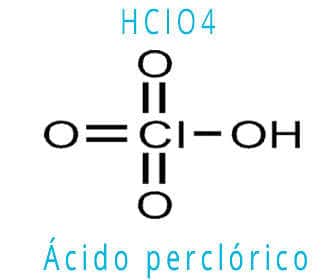
- Semideveloped formula: HClO4.
The production of perchloric acid occurs through the combination of two well known compounds such as chlorine and perchloric oxide together with water or H2O.
Its name comes from chlorine which has an oxidation state of +7 the highest value it can reach.
Another characteristic or property of perchloric acid is that its pKa is the lowest among known strong acids so when it comes into contact with water and an aqueous solution is prepared it dissociates easily and is decomposed into smaller molecules forming other chemical elements.
Uses
Currently it has many industrial and scientific applications and is a key element in many research studies. It is included in the manufacture of many chemical substances as well as in the field of technology because the uses of perchloric acid are: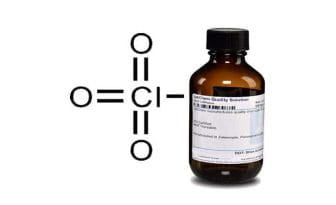
- As a precursor of pure ammonium perchlorate.
- As a cleaning agent for pipes and drains.
- To remove metal rust.
- To produce the primer for artificial nails.
- As a disinfectant.
- To refine metals.
- For bleaching.
- To manufacture plant fertilizers and chemical fertilizers.
- In photographic development.
- Manufacture of explosives.
In the arms industry perchloric acid is used due to its explosive power. It is used to manufacture military equipment as well as bullets and ammunition of different calibers. It is the base used to obtain pure ammonium perchlorate a key element in many modern explosives as also occurs with nitrous acid.
This characteristic also makes it useful in propulsion as it is included as a compound to move missiles and propel rockets.
In the civil field in the industry it is very well known because it is used for bleaching removing metal rust and serving in metal refining.
In the home it is present as an ingredient in cleaning products for bathrooms and toilets as well as in treatments to remove rust from metal parts. Although in high concentrations it is quite dangerous at lower concentrations it is applied in cleaning products as occurs with chloric acid which also serves as a disinfectant and bleaching agent and is formed from chlorine. At the same time it also has similarities with the chromic acid formula since it is very corrosive and removes rust and limescale.
Another use of perchloric acid in medicine is as an analytical reagent. Sometimes it works as a marker to detect different pathogens and abnormal formations in humans.
Safety data sheet
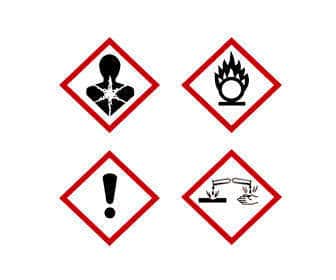
- Explosion hazard.
- May cause fires.
- Corrosive on contact with metals.
- Harmful to people through contact or ingestion.
- It is a product that causes skin burns.
- Hazardous to mucous membranes and ocular tissue.
- Prolonged exposure causes serious harm to people.
It must be stored in a dry and well ventilated place avoiding heat sources. Above certain temperatures indicated in its properties a chemical reaction is possible. During storage the data indicated in the safety data sheet must always be taken into account.
Likewise its handling must be carried out with proper protection using gloves a protective mask and goggles to avoid contact with the eyes and mucous membranes.
If it has been ingested by accident you must go to an emergency hospital while rinsing the mouth. Vomiting must not be induced since passing again through the digestive tract may cause new burns and irreversible damage. If vapors or a drop have come into contact with the eyes you must rinse with water for several consecutive minutes and seek immediate medical attention so that appropriate measures can be taken and thus avoid the toxicity of perchloric acid and the risks to human health and that of animals pets and livestock.
Toxicity
In this field it is quite dangerous since it produces coagulation necrosis. It attacks epithelial cells when hydrogen ions are released. Among the side effects produced by perchloric acid toxicity are:
- Edema.
- Erythema.
- Necrosis.
- Ulcer formation.
- Eschar formation.
- Superficial blisters.
- Erosion.
- Gastric and esophageal stenosis.
- Irreversible damage to the gastrointestinal mucosa when ingested.
- Esophageal perforation.
- Fistula formation.
- Gastrointestinal hemorrhage.
- Dyspnea.
- Chest pain.
- Burns to the pharynx larynx and airways through which vapors pass.
Skin contact is harmful producing burns that may be moderate or severe. Likewise in cases of ingestion or inhalation of perchloric or tetraoxochloric acid it causes damage to the body affecting the nasal mucous membranes and the rest of the respiratory tract.
Whenever you handle it or are going to carry out work with it you must protect yourself properly. The uses of the perchloric acid formula are necessary in many cases but always with appropriate safety measures.